
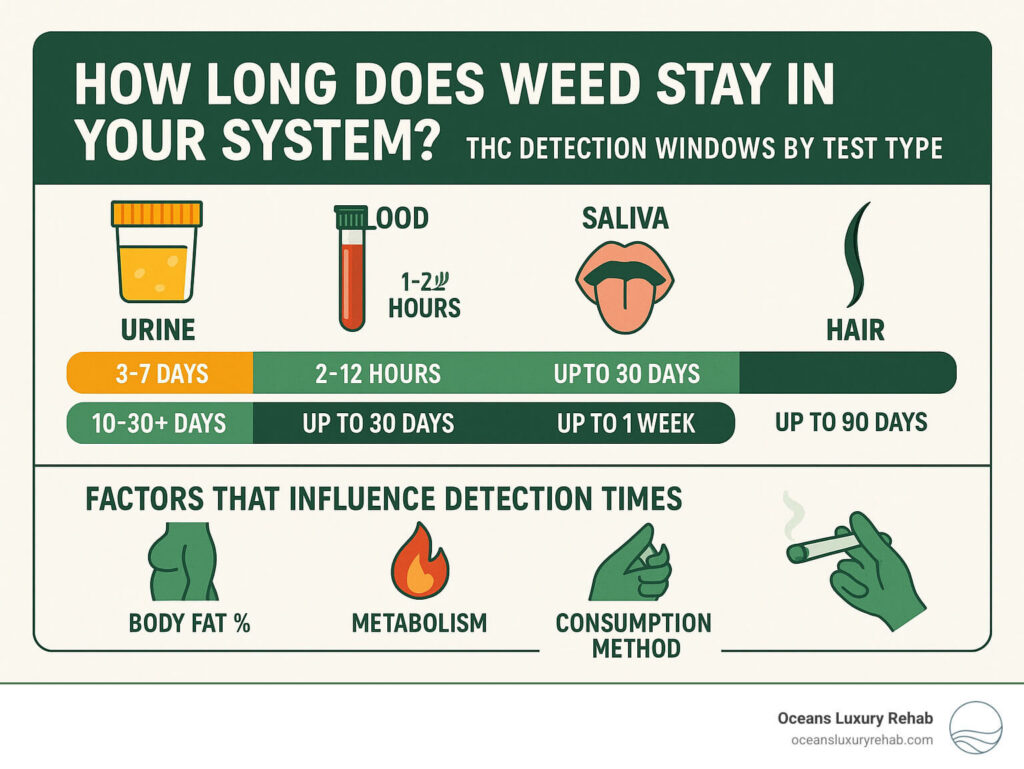
It's one of the most commonly searched cannabis questions out there, and for good reason — whether you're facing a workplace drug test, thinking about driving, or just curious, the honest answer is more complicated than a single number. THC detection time depends heavily on what kind of test is used, how often you use cannabis, and a handful of individual factors that vary person to person. Here's a genuinely thorough breakdown.
Test TypeOccasional UseChronic/Heavy UseBlood1–2 daysUp to a weekSaliva1–3 daysUp to 7+ daysUrine3 daysUp to 30 days or moreHairUp to 90 daysUp to 90 days
These are general ranges, not guarantees — actual detection time for any individual can fall outside these windows depending on the factors covered below.
This is the single most important thing to understand, and it's the source of most confusion around this topic: a positive drug test only proves cannabis use happened within a certain window — it does not measure current impairment. THC and its metabolites can remain detectable in your body long after the actual high has worn off, sometimes by weeks. The psychoactive effects of THC typically last only 3-4 hours after use, but the compound itself is fat-soluble and gets stored in body fat, then slowly released back into the bloodstream over time — which is exactly why heavy or long-term users can test positive well after they last felt any effect.
Blood tests have the shortest detection window of the major test types — typically 1-2 days for occasional use, though chronic heavy users have shown detectable THC in blood for up to 25 days in some research. Because THC clears from the bloodstream relatively quickly compared to other test types, blood tests are used less often for general drug screening and are more commonly associated with situations like impaired driving investigations, where recent use is specifically what's being assessed.
Saliva testing has become increasingly common for roadside and workplace testing because it's easy to administer and correlates reasonably well with recent use. Typical detection windows run:
One detail worth knowing: THC can enter saliva through secondhand smoke exposure alone, but the actual metabolites that confirm personal use only show up if you've smoked or ingested cannabis yourself — meaning being in a room with smokers won't produce a false positive on a properly designed test.
Urine testing is the most common method used by employers and in legal contexts, largely because it's inexpensive and has a longer detection window than blood or saliva — which, depending on your situation, is either the point or the problem. General guidelines suggest:
Edibles specifically are still detectable through urine testing even though they're metabolized differently than smoked cannabis — your liver breaks down THC into the same detectable metabolites regardless of how it entered your system, whether inhaled or ingested.
Hair follicle testing has by far the longest detection window — commonly cited at up to 90 days, since THC metabolites circulating in your bloodstream become incorporated into the hair shaft as it grows, creating a longer-term record. It's worth knowing this method has real limitations: research has found it's considerably better at detecting heavy or daily use than occasional use, with one study finding 75% of self-reported heavy users tested positive via hair sample compared to only 39% of self-reported light users. In other words, hair testing can genuinely miss occasional or infrequent cannabis use.
A number of individual factors can meaningfully shift where you fall within these general ranges:
Short answer: no reliable scientific evidence supports the idea that detox kits, excessive water intake, or other common "quick fix" methods meaningfully speed up how fast your body actually metabolizes and clears THC. Since THC is stored in fat tissue and released gradually, there's no fast biological shortcut around that process. Diluting urine with large amounts of water can sometimes lower the concentration of metabolites in a single sample, which is part of why many tests also check creatinine levels to flag suspiciously diluted samples — but this doesn't change how much THC is actually still in your system.
Detection time is also directly relevant to Ontario's cannabis and driving laws, which are separate from workplace or general drug testing. Ontario has zero tolerance for any detectable THC for drivers holding a G1, G2, or commercial licence — meaning any measurable presence, regardless of whether you feel impaired, is an offence for those licence classes. Fully licenced G drivers are held to Canada's federal impaired driving THC blood-concentration limits instead. Given how long THC can remain detectable — well beyond when its effects have worn off — this is worth understanding clearly if you drive regularly and use cannabis, since "I don't feel high anymore" and "I would pass a THC test" are genuinely two different things.
There's no single universal answer to how long weed stays in your system — it depends heavily on the test type, how often and how much you use, and individual factors like body fat and metabolism. If you're facing a specific test with real consequences, the safest approach is to treat any of these ranges as a floor, not a guarantee, and give yourself more time than the minimum estimate suggests, particularly if you're a regular or heavy user.
This article is for general informational purposes and is not medical or legal advice. If you have a specific concern about an upcoming test — employment, legal, or otherwise — consult with a relevant professional rather than relying solely on general detection-time estimates.
Whatever your reason for understanding THC detection windows, Greenbank Cannabis is here to help you make informed choices about your cannabis use. Browse our full selection of flower, edibles, and more at our Orléans location, or check our online menu for current stock and same-day delivery options.
Must be 19+ with valid government-issued photo ID to purchase. Greenbank Cannabis is an AGCO-licensed cannabis retailer serving Orléans, Cumberland, Beacon Hill, Blackburn Hamlet, and Ottawa East.