
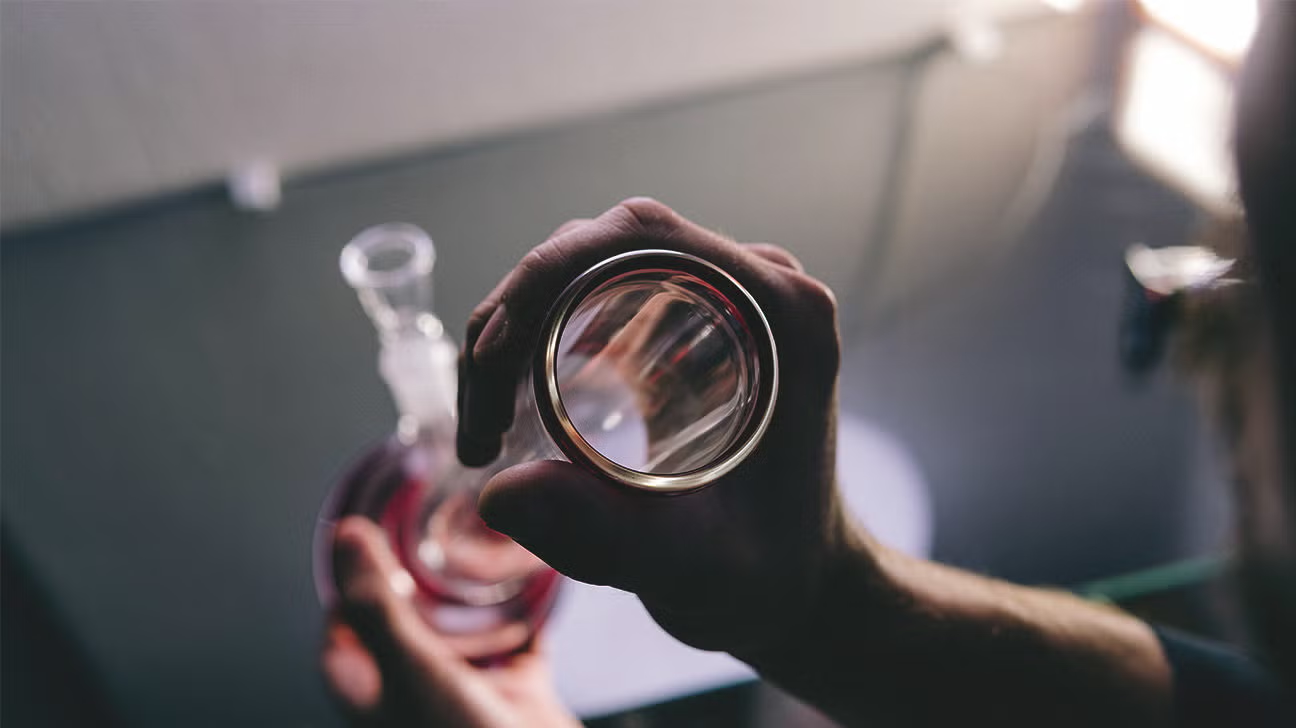
Ask around any dispensary or head shop and you'll hear the same claim repeated with total confidence: bongs are healthier because the water filters out the bad stuff. It's one of the most widely repeated pieces of cannabis folk wisdom out there. It's also, according to the actual research, considerably more complicated than that — and in some respects, just not true. Here's an honest look at what the science actually says, not what sounds intuitive.
The logic behind the claim is straightforward enough: smoke bubbles up through water before you inhale it, so surely some of the harmful stuff gets trapped along the way. You can even see the appeal visually — anyone who's cleaned a dirty bong has seen the residue left behind in the water, which seems like obvious proof that something is being filtered out.
Older research on tobacco water pipes lent some real support to this idea. A 1963 study published in the Journal of the National Cancer Institute found that water filtration reduced the quantity and number of toxins in tobacco smoke, and epidemiological research has since found lower rates of certain cancers among tobacco water-pipe users compared to cigarette or dry-pipe smokers. That's meaningful evidence — but it's about tobacco, not cannabis, and tobacco and cannabis smoke aren't chemically identical.
This is the part that surprises most people: there's been very little direct research on cannabis smoke and water filtration specifically, and what does exist doesn't clearly support the "bongs are healthier" claim.
The most direct recent test came from a 2025 study out of the University of Wisconsin-Madison, working with researchers in Thailand. The team used gas chromatography-mass spectrometry — a precise method for identifying chemical compounds by molecular weight — to compare the actual chemical makeup of smoke produced by joints versus bongs, across three different cannabis strains. Their conclusion: bong water did not appear to meaningfully filter out any of the compounds they measured. The smoke composition from joints and bongs came out largely the same.
That's a genuinely surprising result given how confidently the opposite claim gets repeated. The researchers were careful to note real limitations in their method — their equipment wasn't built to detect larger particles, aerosols, or metal ions, which water could theoretically still trap even if it's not filtering the specific gas-phase compounds they measured. So this isn't a final, settled answer. But it's a direct challenge to the assumption that water filtration meaningfully cleans cannabis smoke.
An earlier, smaller machine study from the 1990s produced an even more counterintuitive finding: when researchers compared an unfiltered joint to several water pipes, the water pipes actually removed proportionately more cannabinoids than smoke particles — meaning filtration wasn't selectively stripping out the "bad stuff" while preserving THC. If anything, it was doing something closer to the opposite.
None of this means water pipes offer nothing. The research is much more consistent on a narrower claim: water cools the smoke and traps at least some larger ash particles before they reach your mouth and throat. That's a real, well-supported effect — it's just a comfort and smoothness benefit, not necessarily a safety one. A cooler hit feels less harsh, which is a genuinely different thing from being less harmful.
The most accurate summary of where the research currently stands: both bongs and pipes involve combustion, and combustion — burning plant material and inhaling the resulting smoke — is the primary source of respiratory risk with either method, not the specific hardware you're using. Neither device eliminates that basic fact. If minimizing respiratory exposure is genuinely your priority, the research is far more consistent in supporting vaporizers, which heat cannabis below the point of combustion and avoid producing much of the smoke-related byproduct entirely, as the more meaningfully different option — a difference between combustion and non-combustion methods, not between two combustion methods.
A few things the research and harm-reduction guidance consistently point to, regardless of whether you're using a bong or a pipe:
If you've been choosing a bong over a pipe because you believed it was the meaningfully "safer" option, the current research doesn't back that up as clearly as the popular wisdom suggests — the water is real, but its actual filtration effect on cannabis smoke specifically remains unproven and possibly minimal, based on the most rigorous testing done so far. What a bong reliably does offer is a cooler, smoother hit — a genuine comfort benefit, just not the health benefit it's often marketed as.
If lung health is a real priority for you rather than just a nice-to-have, the more meaningful choice isn't bong versus pipe — it's combustion versus non-combustion, meaning vaporizing or another smoke-free format is where the actual evidence-backed difference shows up.
This article is for general informational purposes and reflects publicly available research at the time of writing — it is not medical advice. If you have respiratory concerns or existing lung conditions, talk to a healthcare provider about what consumption method may be appropriate for you.
Whether you land on a bong, a pipe, or want to explore vaporizers as a lower-combustion alternative, Greenbank Cannabis carries a full range of smoking and vaping accessories at our Orléans location. Browse what's currently in stock on our online menu, or stop by in person where our team can walk you through the tradeoffs of each based on what actually matters to you.
Must be 19+ with valid government-issued photo ID to purchase. Greenbank Cannabis is an AGCO-licensed cannabis retailer serving Orléans, Cumberland, Beacon Hill, Blackburn Hamlet, and Ottawa East.